

An automotive switch panel provides a centralized way to control auxiliary electrical equipment in a vehicle. Depending on the system, it can manage driving lights, work lights, cooling fans, water pumps, air compressors, warning lights and other compatible 12V or 24V accessories.
However, not all automotive switch panels are designed to the same standard.
Two products may look almost identical from the outside but differ significantly in current capacity, circuit protection, wiring quality, environmental durability, control functions and long-term reliability.
For off-road accessory brands, vehicle modification companies, distributors, importers and OEM/ODM buyers, choosing the right switch panel is therefore not simply about comparing the number of buttons or the purchase price.
A high-quality automotive switch panel should match the vehicle electrical system, connected loads, installation environment and expected control method while providing reliable operation over long-term use.
This guide explains eight important factors to check before choosing a 12V or 24V automotive switch panel.
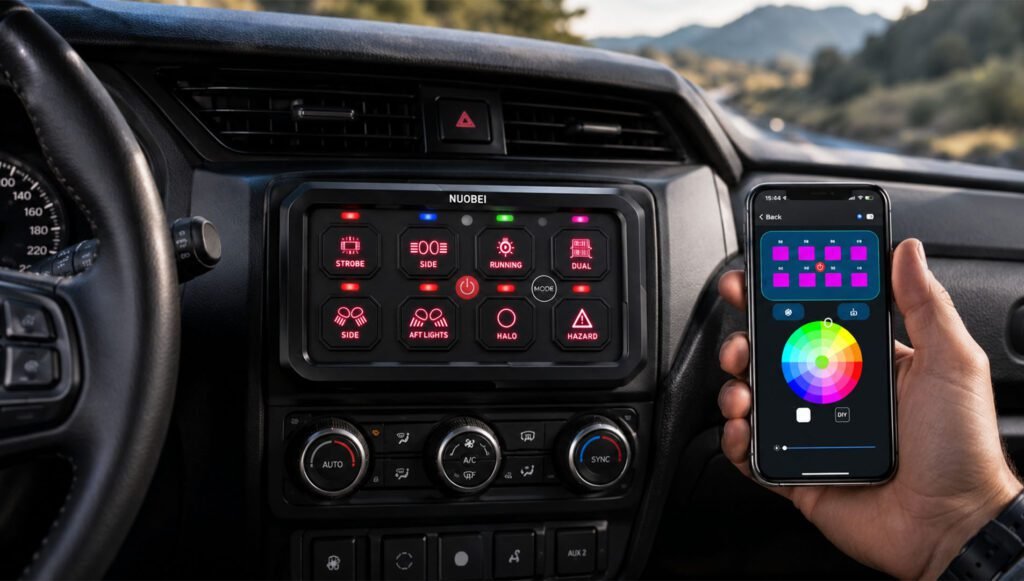
Table of Contents
- What Is an Automotive Switch Panel?
- High-Quality vs Basic Switch Panel: What Should Buyers Compare?
- Which Automotive Switch Panel Is Right for Your Application?
- Example: When Does a 120A 8 Gang Switch Panel Make Sense?
- Questions to Ask Before Buying an Automotive Switch Panel
- Why Manufacturing Capability Matters for B2B Buyers
- Final Thoughts
- Frequently Asked Questions
What Is an Automotive Switch Panel?
An automotive switch panel is an electrical control system used to manage multiple vehicle accessories from one centralized interface.
Instead of installing a separate switch and independent control circuit for every accessory, a multi-gang switch panel organizes several electrical functions into one system.
Typical applications include:
Driving and auxiliary lights, work lights, light bars, cooling fans, air compressors, water pumps, warning lights, camping equipment, ventilation equipment and other compatible vehicle electrical accessories.
Automotive switch panels are commonly installed in 4×4 vehicles, off-road vehicles, UTVs, trucks, RVs, campers, trailers, utility vehicles and marine applications.
Depending on the product design, control may be provided through physical buttons, a wired panel, wireless communication, a remote controller, a Bluetooth APP, or a combination of several control methods.
The important point is that an aftermarket automotive switch panel should be evaluated as part of the complete vehicle accessory electrical system—not simply as a row of buttons.
1. Check Total Current Capacity and Individual Channel Ratings
Current capacity is one of the first specifications buyers should check when comparing automotive switch panels.
A product described as a “6 gang” or “8 gang switch panel” tells you how many circuits it can control, but it does not tell you how much electrical load the system can safely support.
There are two specifications that should be considered separately:
Total maximum current refers to the maximum current capacity of the complete control system.
Individual channel current refers to the maximum current assigned to each output.
These values are not always the same across every channel.
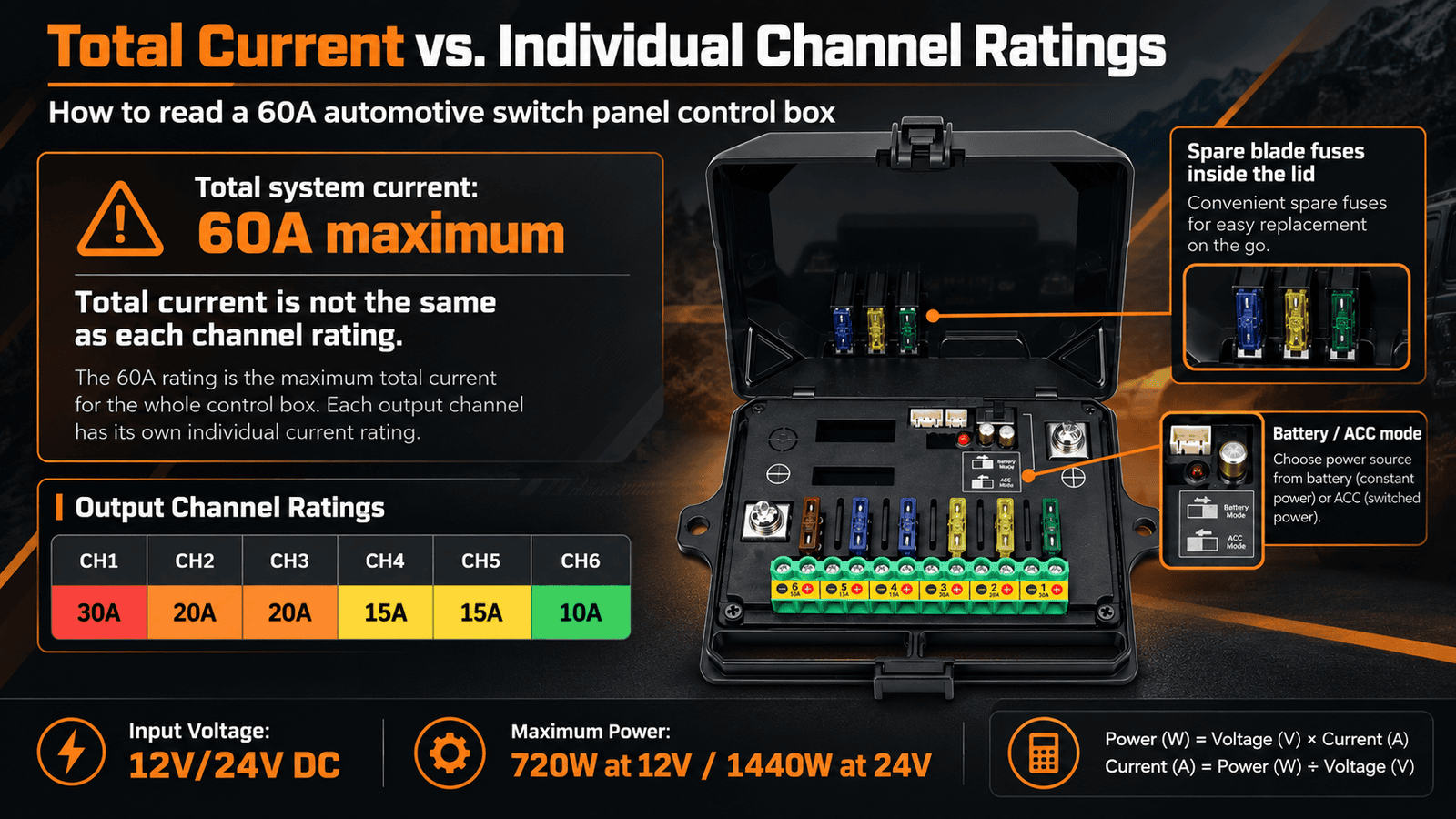
For example, a switch panel may provide a combination of 10A, 15A, 20A, 30A or higher-current outputs so different accessories can be connected according to their electrical requirements.
A higher-current driving light or electrical device should not automatically be connected to an arbitrary channel simply because that channel is available.
Before choosing a switch panel, determine the current requirements of the accessories you expect to control.
A simple electrical calculation can help:
Power (W) = Voltage (V) × Current (A)
For example, the same current capacity represents different available power in a 12V system compared with a 24V system.
Buyers should therefore check both voltage compatibility and current capacity rather than relying only on the advertised gang quantity.
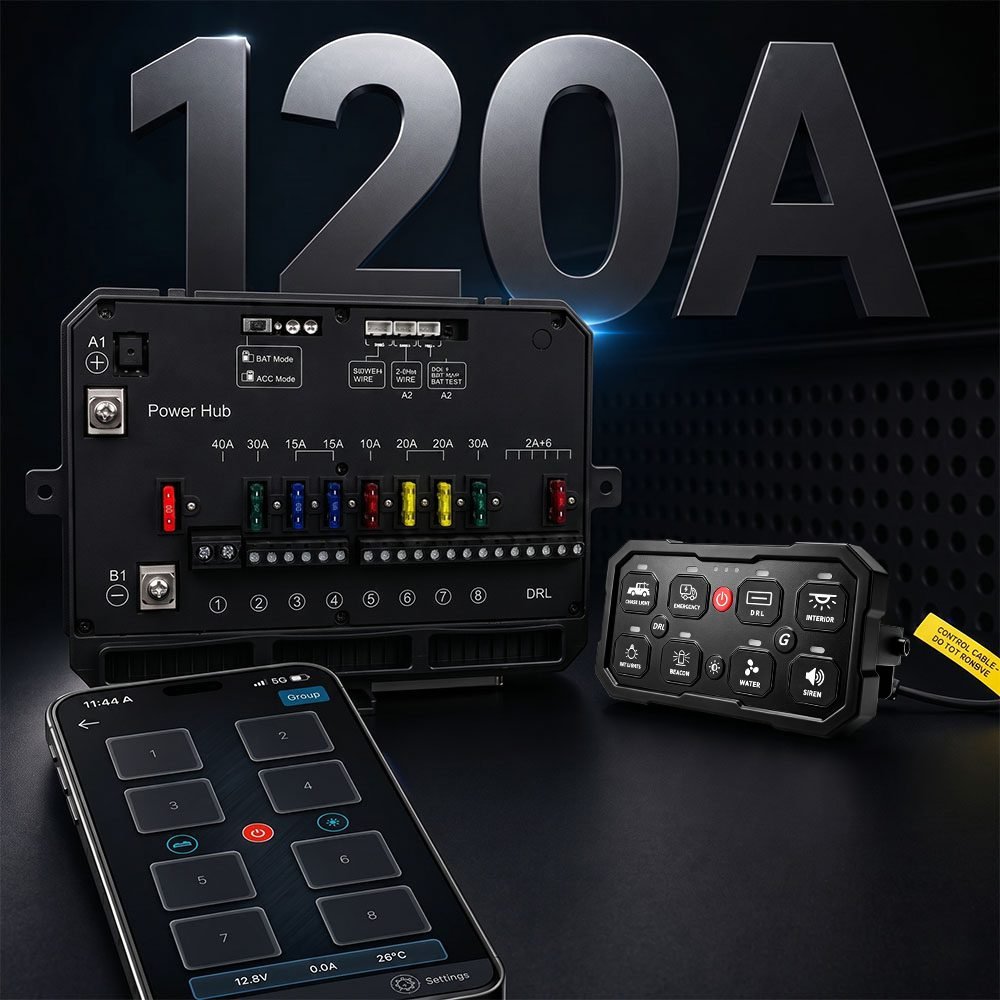
For more demanding electrical systems, a high-current platform may be appropriate. For example, NUOBEI’s SAM-BCSP08 is an 8 gang Bluetooth switch panel designed with up to 120A total maximum current and different current ratings across its eight main output channels.
The correct specification depends on the actual electrical loads being connected.
Buyer Tip
Before requesting a quotation, prepare a list of the accessories that will be connected to the switch panel and their approximate current or power requirements.
This allows the manufacturer to evaluate whether a 60A, 80A, 120A or other configuration is appropriate for the project.
2. Evaluate Circuit Protection and System Monitoring
A high-quality automotive switch panel should do more than turn accessories on and off.
Electrical protection and system monitoring can be particularly important in vehicles where several accessories operate from the same battery and electrical system.
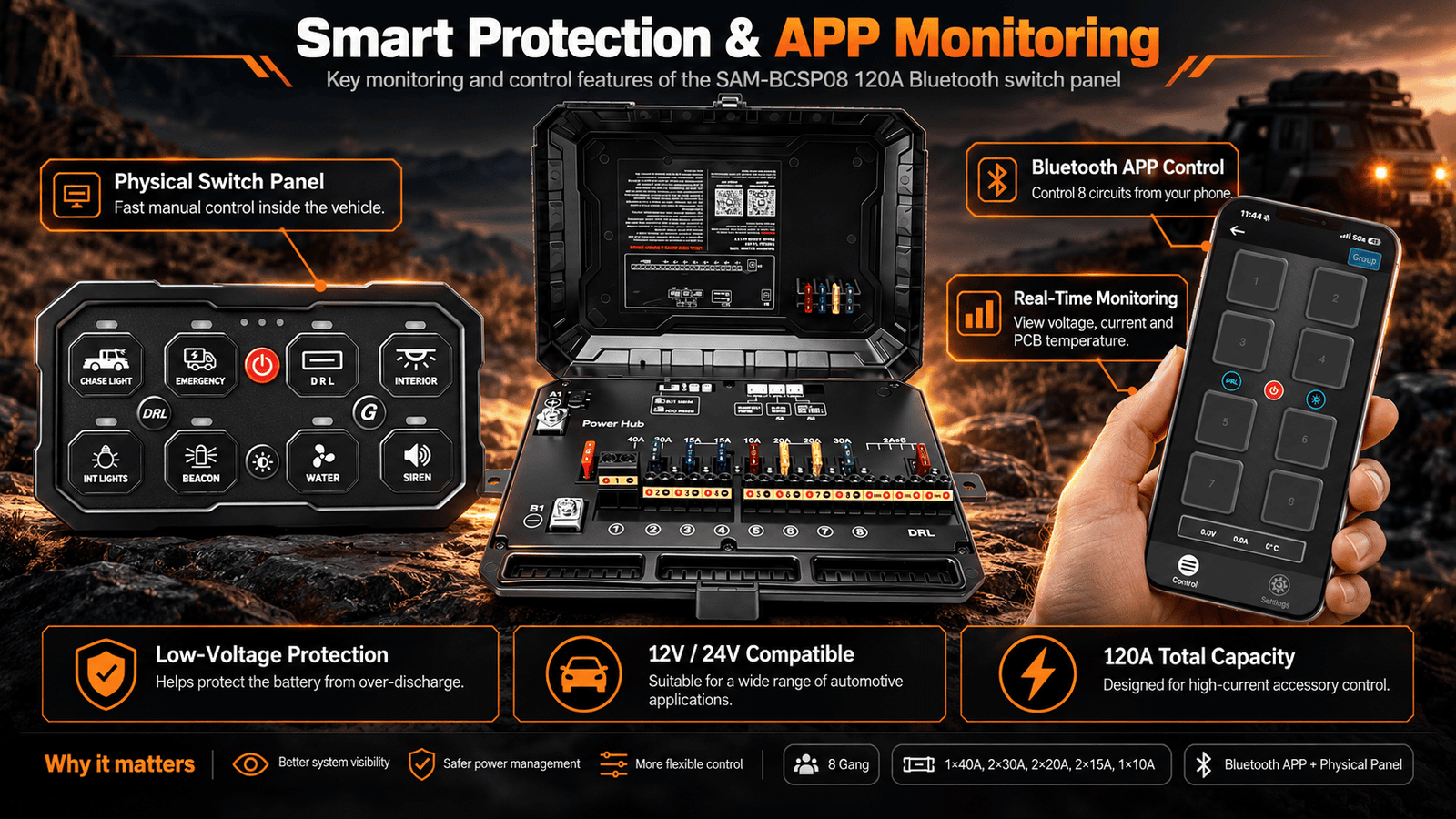
Depending on the switch panel design, useful functions can include:
Low-voltage protection, current monitoring, voltage monitoring, temperature monitoring and programmable operating settings.
Low-voltage protection can be particularly useful when multiple accessories are connected to a vehicle battery.
If electrical equipment continues operating while battery voltage becomes too low, the vehicle may eventually have insufficient battery capacity for normal operation or starting.
More advanced switch panel systems can provide real-time information through a mobile APP or controller so users can monitor the electrical system more easily.
For B2B buyers, however, the important question is not simply whether a product has more functions.
The more important questions are:
Does the protection function match the application?
Can the system provide clear information about its operating status?
Are the protection thresholds fixed or adjustable?
Has the system been properly tested?
A simpler system with appropriate protection and stable operation may be more suitable than a more complicated product with unnecessary functions.
3. Choose the Right Control Method: Wired, Wireless, Remote or Bluetooth APP
Modern automotive switch panels are available with several control methods.
There is no single control method that is best for every application.
The correct choice depends on where the product will be installed and how the end user expects to operate connected equipment.
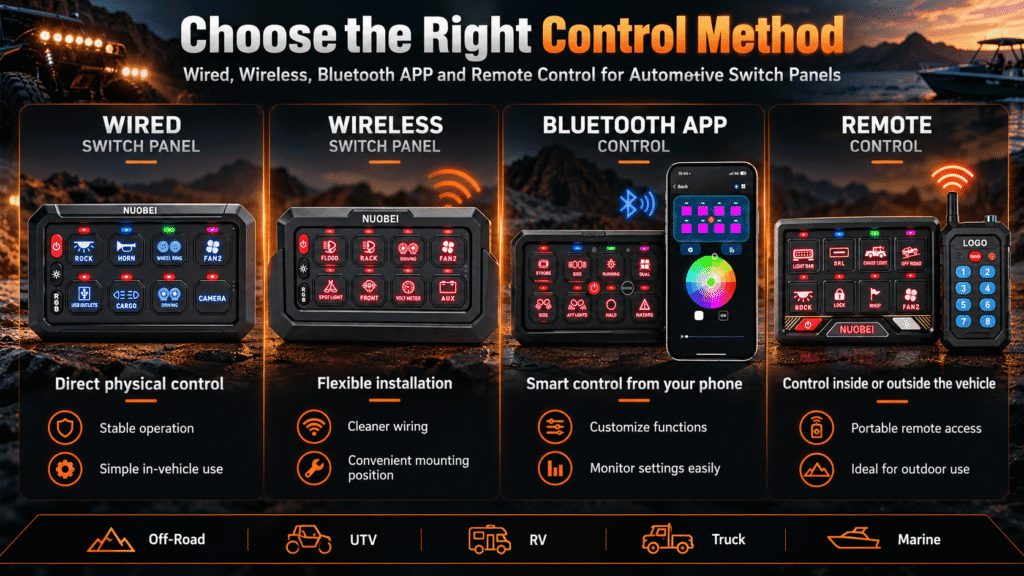
Wired Switch Panel
A wired switch panel uses a physical communication connection between the control panel and the electrical control system.
This type of design can be useful when buyers prioritize straightforward physical control and do not require wireless operation.
Wired systems are commonly suitable for fixed installations where the panel remains in a permanent dashboard or console position.
Wireless Switch Panel
A wireless switch panel reduces the need to route a traditional signal cable between the panel and control box.
This can provide greater flexibility when choosing the panel installation position.
Wireless control can be useful in off-road vehicles, campers, utility vehicles and other applications where installation convenience is important.
For a practical example, see how wireless switch panels can be used for camping and off-grid electrical systems.
Remote Control Switch Panel
A remote-control system allows compatible accessories to be controlled from outside or around the vehicle.
This can be useful for work lights, camping equipment, warning lights or other accessories that users may need to operate without remaining in the driver’s seat.
Bluetooth APP Switch Panel
A Bluetooth switch panel combines physical vehicle controls with smartphone-based operation.
Depending on the product, APP functionality can provide additional settings such as customized switch names, icons, backlight settings, operating modes or system monitoring.
Physical buttons remain important because they provide immediate control inside the vehicle, while APP control adds another level of flexibility.
The best automotive switch panel is therefore not necessarily the one with the greatest number of control methods.
It is the one whose control method matches the customer’s vehicle, installation environment and target market.
4. Examine Wiring Harnesses, Connectors and Installation Design
The switch panel itself is only one part of the system.
Wiring harnesses, connectors, terminals and mounting components can have a major effect on installation quality and long-term reliability.
Before selecting a product, buyers should evaluate how the complete system will be installed.
Important factors include connector design, wire specifications, harness length, mounting position, power connection, accessory connection and available installation space.
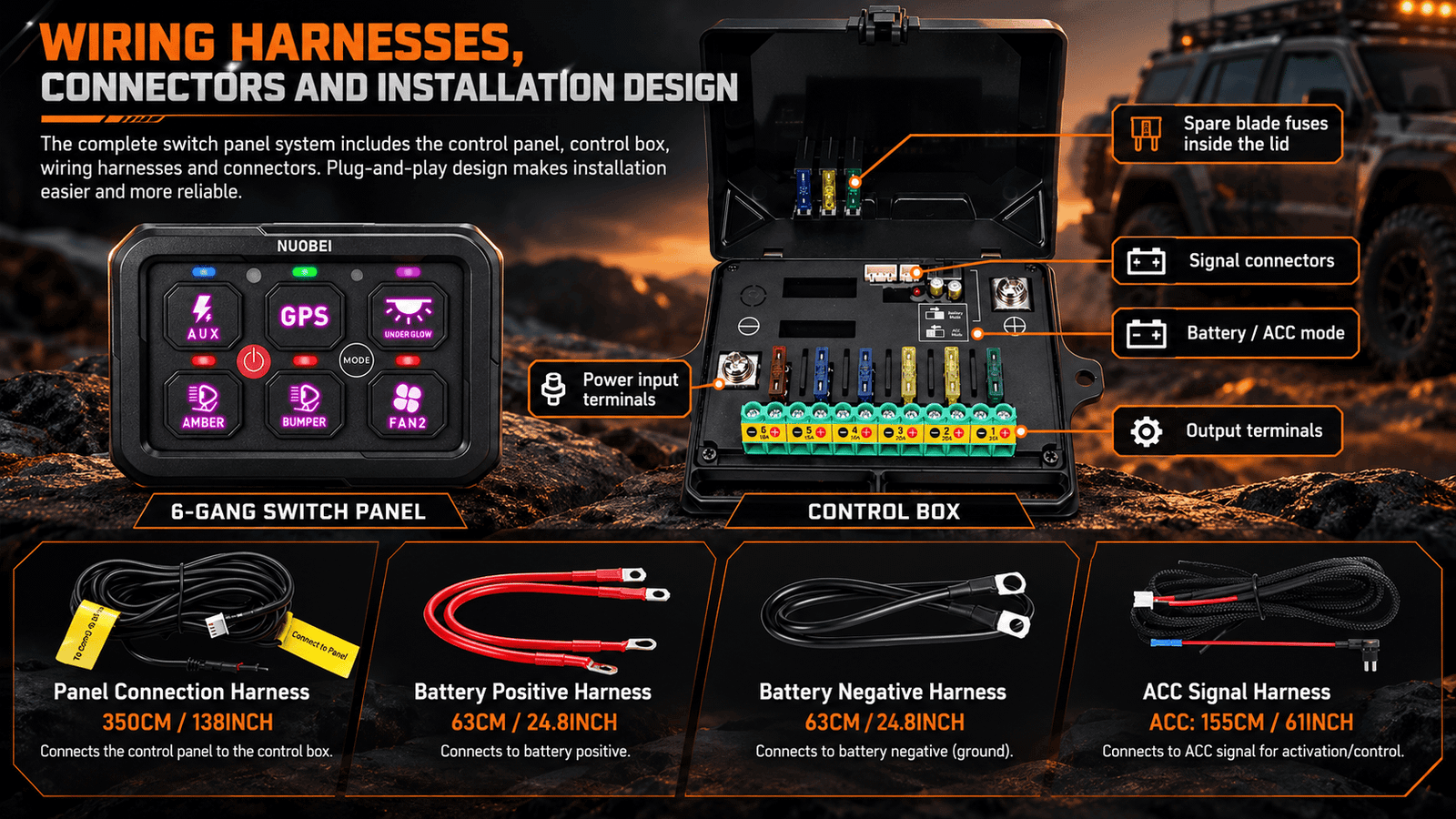
For an OEM or private-label project, standard wiring may not always be suitable.
Different vehicles and target markets can require different harness lengths, connector types or installation arrangements.
This is one reason OEM/ODM capability matters for professional buyers.
A supplier that can customize only the logo may not be able to solve electrical integration or installation problems.
For more advanced projects, buyers should discuss wiring harness configuration and connector requirements during the product-development stage instead of waiting until mass production.
Wire size, fuse selection and circuit configuration should always be matched to the actual electrical load and installation requirements.
5. Check Environmental Durability
Vehicle electronics operate in a much more demanding environment than typical indoor electronics.
An automotive switch panel may be exposed to temperature changes, vibration, dust, moisture and repeated physical operation.
Off-road, utility and marine installations can create even more demanding conditions.
For this reason, environmental durability should be evaluated according to the intended application.
Useful specifications may include:
Operating temperature range, dust and water protection, enclosure design, connector protection and corrosion resistance.
An IP rating can provide useful information about enclosure protection, but it should not be considered the only indicator of product quality.
Buyers should also consider where the panel and control box will actually be installed.
A dashboard installation and an engine-bay or exterior installation involve very different environmental conditions.
Similarly, marine, off-road and industrial vehicles can create different requirements for moisture, vibration and corrosion resistance.
For B2B sourcing, ask the supplier what environmental tests are performed and which parts of the product the published specifications apply to.
Specific test information is more useful than general statements such as “waterproof” or “heavy duty.”
6. Evaluate Button Layout, Backlighting and Everyday Usability
Electrical performance is essential, but the user interface should not be ignored.
Drivers often operate auxiliary equipment while concentrating on driving or working.
Controls should therefore be easy to identify and operate.
A good panel layout should provide clear button separation, recognizable labels or icons and suitable backlighting for low-light conditions.
Different products may use fixed symbols, replaceable labels or customizable graphics.
RGB backlighting can provide additional customization, especially for aftermarket automotive brands, but usability should remain the priority.
For private-label projects, customized button icons and graphics can also help differentiate the product from generic switch panels.
Instead of evaluating only how attractive a panel looks in product photos, consider how easily the end user can identify and operate each function after installation.
7. Verify Testing and Quality Control Before Mass Production
One of the most important differences between switch panel suppliers is not always visible in the product photograph.
It is the quality-control process behind the product.
A sample can perform correctly while bulk production still creates quality problems if manufacturing and testing are inconsistent.
For brands, distributors and importers, this creates additional risks such as customer complaints, returns, negative reviews and higher after-sales costs.
Before placing a bulk order, buyers should understand how the switch panel is manufactured and tested.
Buyers who want to understand the complete production process can also see how automotive switch panels are made from component production through assembly and testing.
Depending on the product and manufacturing process, testing may cover electrical functions, buttons, communication, operating modes, voltage conditions, temperature conditions or other application-related requirements.
Manufacturing consistency is also important.
PCB assembly, wiring, connectors, housing components, button assemblies and software settings all need to remain consistent between samples, mass production and repeat orders.
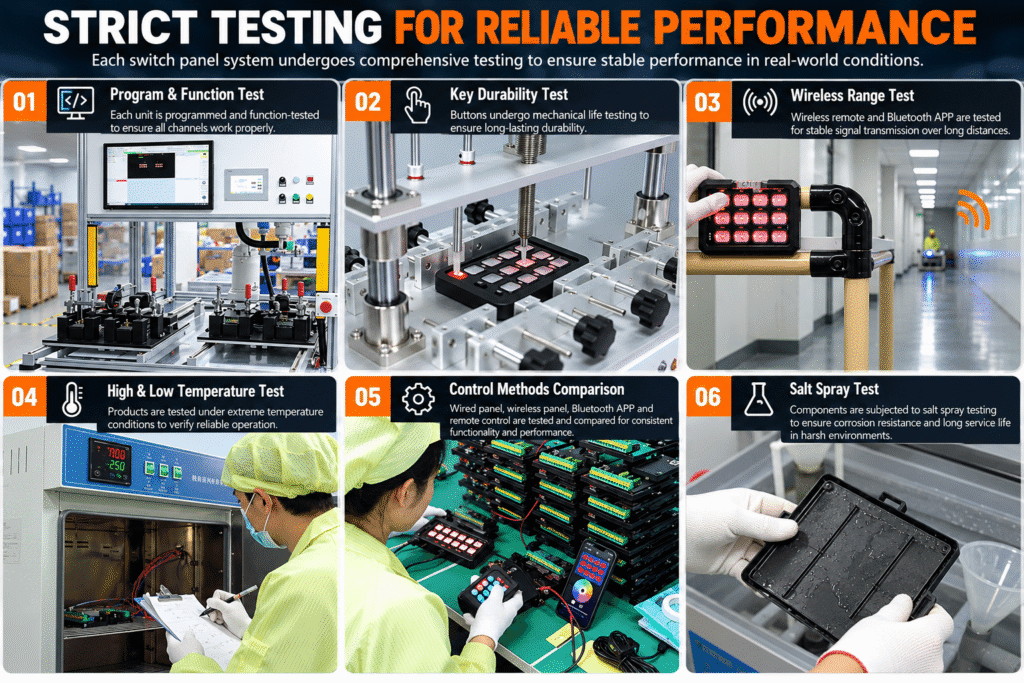
At NUOBEI, switch panel production includes processes such as component and PCB manufacturing, assembly and functional testing, with products tested before shipment.
For purchasing customers, documented testing procedures and clear specifications provide more useful evidence than a simple claim that a product is “high quality.”
8. Check OEM/ODM Customization and Repeat-Order Consistency
For a retail consumer, selecting a switch panel may end after choosing the required specifications.
For B2B buyers, the decision is more complicated.
Brands, distributors and importers also need to consider whether a supplier can support product differentiation, stable repeat orders and future product development.
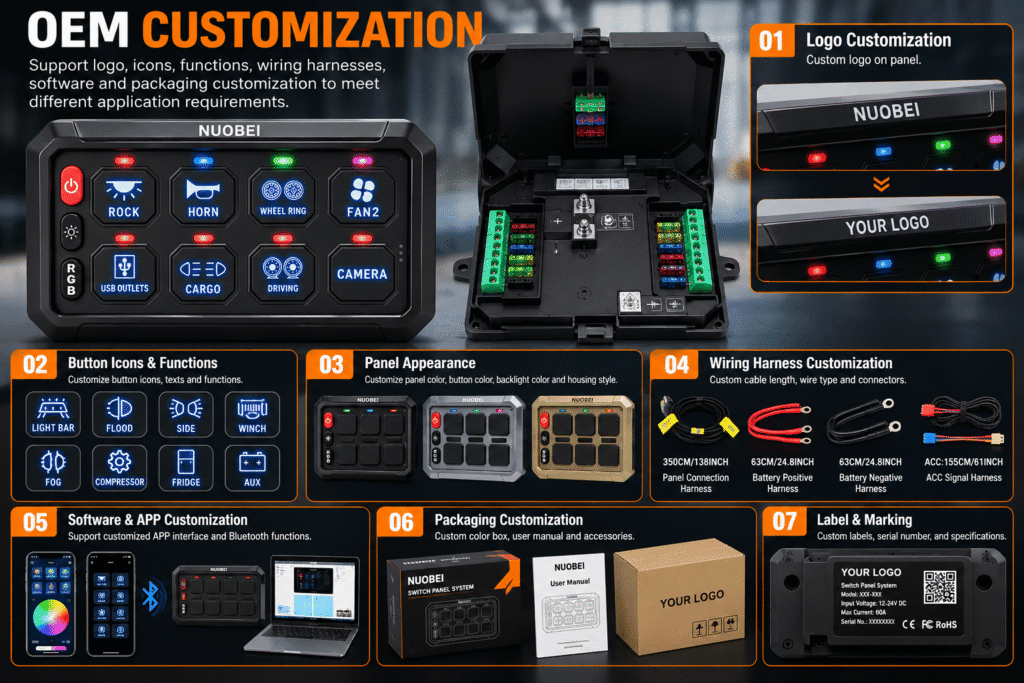
OEM and ODM customization can include much more than placing a logo on the panel.
Depending on the project, customization may involve:
Brand graphics, button icons, label sets, backlighting, control functions, wiring harnesses, connectors, instruction manuals and retail packaging.
More advanced ODM projects may also require changes to product configuration, installation arrangements or control functions.
However, customization is useful only when it can be reproduced consistently.
A customized sample that cannot be manufactured reliably in bulk does not create a sustainable product line.
B2B buyers should therefore evaluate both development capability and production consistency.
Before confirming an OEM/ODM order, make sure the supplier clearly documents the approved product specifications, packaging requirements and other customized details.
Product specifications are only part of a sourcing decision. B2B buyers should also evaluate supplier quality control, customization capability, supply stability and after-sales support.
High-Quality vs Basic Switch Panel: What Should Buyers Compare?
Price alone does not indicate whether an automotive switch panel is suitable for a project.
A better comparison should include the complete electrical system and sourcing requirements.
| Evaluation Factor | Basic Evaluation | Professional Buyer Evaluation |
| Gang quantity | Number of buttons | Number of required circuits |
| Current | General advertised rating | Total current + individual channel ratings |
| Voltage | Product powers on | Correct 12V/24V compatibility |
| Protection | Basic ON/OFF function | Appropriate electrical protection and monitoring |
| Control method | More functions appear better | Control method matches application |
| Wiring | Included in the package | Correct harness, wire and connector configuration |
| Durability | Product looks strong | Environmental specifications and test information |
| User interface | Attractive appearance | Clear operation, icons and backlighting |
| Quality | Sample works | Stable testing and repeat-order consistency |
| OEM | Logo printing | Product, function, harness, documentation and packaging support |
The correct purchasing decision depends on the complete application rather than one specification.
Which Automotive Switch Panel Is Right for Your Application?
Different vehicle applications create different priorities.
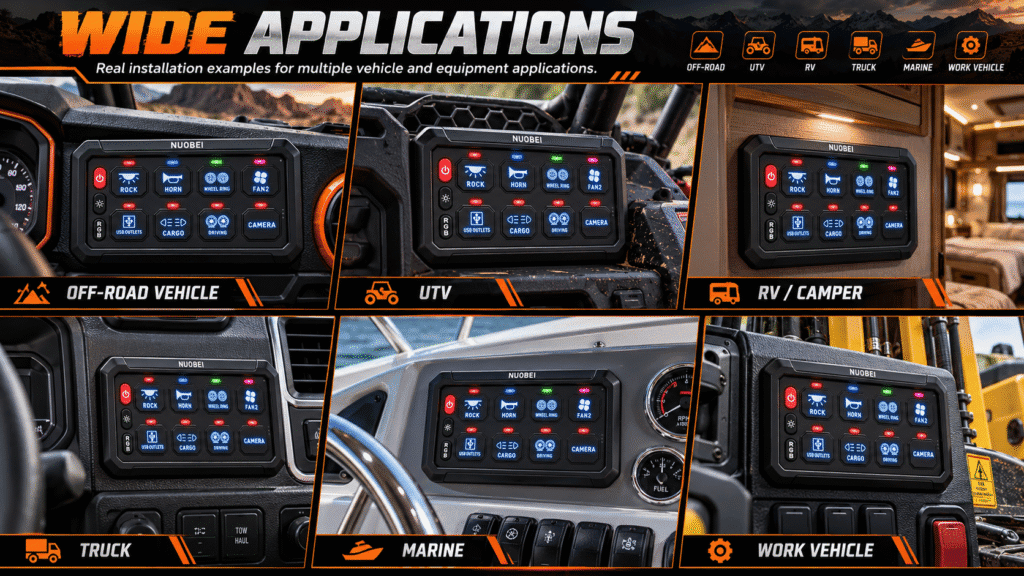
Off-Road and 4×4 Vehicles
Off-road applications often require control of driving lights, light bars, work lights, compressors and other accessories.
Buyers should pay particular attention to current capacity, physical controls, installation strength, dust protection and vibration-related reliability.
UTV and Utility Vehicles
Installation space can be limited in UTVs and utility vehicles.
Compact panel design, clear controls and suitable environmental protection can therefore be particularly important.
RVs, Campers and Off-Grid Vehicles
Camping systems may include exterior lights, water pumps, fans, refrigerators or other compatible electrical accessories.
APP or wireless control can be useful because users may want to operate equipment from different locations around the vehicle or campsite.
Trucks and Commercial Vehicles
Commercial vehicles may use 24V electrical systems and can require higher-current accessory control.
Always confirm system voltage and individual circuit requirements before selecting the switch panel.
Marine Applications
For marine or moisture-prone environments, buyers should pay particular attention to installation location, enclosure protection, connector design and corrosion resistance.
A product should not be assumed to be suitable for every marine installation simply because it has an IP rating.
Example: When Does a 120A 8 Gang Switch Panel Make Sense?
A higher-current switch panel can be useful when a vehicle needs to control several electrical accessories with different load requirements.
For example, the NUOBEI SAM-BCSP08 is a 12V/24V Bluetooth 8 gang switch panel with up to 120A total maximum current.
Its eight main outputs are configured as one 40A, two 30A, two 20A, two 15A and one 10A channel.
The system also supports Bluetooth APP operation, voltage/current/PCB-temperature monitoring and adjustable low-voltage protection.
A configuration like this can be useful when the installation includes both normal accessory loads and one or more higher-current circuits.
However, a 120A switch panel is not automatically the correct solution for every vehicle.
If the connected loads are relatively small, a 60A platform may be completely sufficient.
The correct product should be selected according to actual electrical requirements rather than purchasing the highest specification available.
Questions to Ask Before Buying an Automotive Switch Panel
Before contacting a manufacturer or requesting a quotation, prepare the following project information:
Vehicle system voltage: Is the system 12V or 24V?
Number of circuits: How many accessories need independent control?
Accessory loads: What devices will be connected and how much current does each one require?
Preferred control method: Wired, wireless, remote, Bluetooth APP or a combination?
Installation position: Where will the switch panel and control box be installed?
Environmental conditions: Will the equipment be exposed to dust, moisture, vibration or extreme temperatures?
Customization requirements: Do you need custom logos, button icons, wiring, connectors, manuals or retail packaging?
Order quantity: Are you purchasing samples, a trial order, mass production or repeat orders?
Target market: Will the product be sold to off-road, UTV, RV, truck, marine or another customer segment?
Providing this information allows a manufacturer to recommend a more suitable configuration instead of simply quoting the first available model.
Why Manufacturing Capability Matters for B2B Buyers
For brands and distributors, a switch panel is not only an electrical product.
It is also part of a long-term supply chain.
Once a product begins selling successfully, the buyer needs consistent specifications, stable manufacturing, reliable quality control and repeat-order availability.
This is why buyers should evaluate the manufacturer as well as the product.
NUOBEI develops and manufactures 12V and 24V automotive switch panel systems for brands, distributors, importers and OEM/ODM projects.
Current product platforms include wired, wireless, remote-control and Bluetooth APP solutions, with different gang quantities and current configurations for different vehicle accessory applications.
OEM/ODM support can include branding, button graphics, control functions, wiring harnesses, connectors, manuals and retail packaging.
For buyers building a long-term switch panel product line, these capabilities can be as important as the technical specifications of a single model.
Buyers can also take a closer look inside NUOBEI’s automotive switch panel factory and quality-control process.
Final Thoughts
Choosing a high-quality automotive switch panel requires more than comparing appearance, button quantity or price.
Buyers should evaluate the complete system:
Electrical load requirements, total and individual current ratings, voltage compatibility, circuit protection, control method, wiring, environmental durability, usability, testing and manufacturing consistency.
For B2B customers, OEM/ODM capability and repeat-order consistency should also be considered.
The best switch panel is not necessarily the model with the highest current rating or the greatest number of features.
It is the system that correctly matches the vehicle, connected equipment, installation environment and target market.
If you are sourcing an automotive switch panel for your brand, distribution business or OEM/ODM project, prepare your voltage, number of circuits, accessory loads, preferred control method, installation requirements, customization requirements and expected order quantity.
NUOBEI can then evaluate the project and recommend a suitable standard or customized 12V/24V switch panel platform.
Frequently Asked Questions
What is an automotive switch panel used for?
An automotive switch panel centralizes the control of multiple compatible vehicle electrical accessories, such as auxiliary lights, work lights, fans, water pumps, compressors and other 12V/24V equipment.
Is a 60A or 120A switch panel better?
Neither specification is automatically better. The correct total current capacity depends on the combined electrical loads and individual circuit requirements of the accessories being controlled. A 60A system may be sufficient for many standard installations, while higher-current applications may require a 120A platform.
What is the difference between a wired and wireless switch panel?
A wired switch panel uses a physical communication connection between the panel and the control system. A wireless switch panel communicates without the same traditional signal wiring, which can provide more flexibility when selecting the panel mounting position.
Can automotive switch panels be customized for OEM brands?
Yes. Depending on the manufacturer and product platform, OEM/ODM customization can include logos, panel graphics, button icons, RGB settings, control functions, wiring harnesses, connectors, manuals and retail packaging.
What information should I provide when requesting a custom switch panel?
Provide the vehicle voltage, number of required circuits, accessory current requirements, preferred control method, installation environment, wiring requirements, branding requirements, target market and expected order quantity. This helps the manufacturer evaluate a suitable product configuration.